On Running and Life Lately

After the Marine Corps Marathon, I took nearly two weeks off from running. I did not run a step until November 8, which was 12 days away from running. For the first week, I completely rested. It was just as well, since I had long days at work that week.

I started to feel ready to run again, physically, about five days after my race. But I still needed the mental break from running. Eighteen weeks of training is a lot, and even when I wasn’t able to train I spent all my time thinking about running and fretting over missed training. I think it’s important to take a step back and do some other stuff for at least a short period of time. It keeps you from burning out on the sport you love. Too much of a good thing, and all that.

So during the second week after my marathon, I did some light cross training. It mostly involved some strength training circuits (corework, pushups, lunges, planks, etc.). Finally on Saturday, November 8, I was ready to run and convinced Barry to hit the local mountain bike trails with me. We only ran about 2.5 miles, but it felt so good to be back out there. Which is exactly how I wanted my first post-race run to feel.

mountain trail elevation
We only went halfway up the mountain.

Naturally, having not run trails in quite awhile (aside from that one day), my legs were burning and so were my lungs. But it was good. The only downside was rolling my right ankle on a rock towards the end of the run. My ankle didn’t really hurt afterwards but the area below it, along the side of my heel did. It wasn’t that bothersome, though, so I met up the next morning with Kim for an 11 mile run on the Dora and New River Trails.

I had a great time running with Kim, as we hadn’t run together in a few weeks. I spent nearly 7 miles describing every detail from the Marine Corps Marathon weekend to her. She probably regretted asking me to tell her about it 🙂 I noticed my foot was bothering me a bit from miles 6 – 8, but it went away and I attributed it to the unevenness of the trail during that section. Later that day, though, my foot was swollen and bruised along the outside of my heel and it was pretty painful to walk on. I spent the rest of the day icing it and trying to stay off of it as much as possible.

I had to take off Monday through Wednesday because my right foot continued to be painful. On Monday and Tuesday my foot was pretty painful to walk or stand on. But the bruising and swelling subsided, and it started to feel better by Wednesday. I took Thursday off as well and then cross trained on Friday. It was my first Jillian workout in months, and I could definitely feel that!
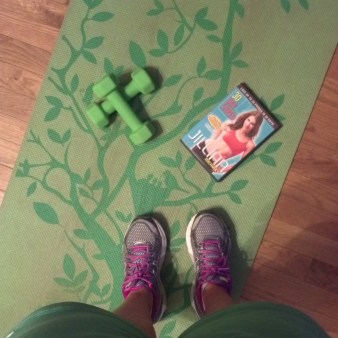
Jillian Michaels 30 Day Shred workout

Saturday morning I met up with Kim in the chilly 20 degree weather for a 6 mile run. We actually met up at the Huckleberry, which was fun and a nice change. I insisted on running some of the new section of trail, so we got some hill work in, too!

huckleberry trail

My foot felt fine the whole run, and despite the chilly weather it felt great to be out running since the air was crisp and the sun was shining. It was also exciting to see they have almost finished the bridge that will connect the old section of trail to the new part!

huckleberry trail new bridge

Once we finished running I changed into a dry set of clothes and made use of my trip to the area by doing some Christmas shopping. I know it’s kind of early, but I can’t stand the crowds after Thanksgiving! During my shopping, I noticed my right foot was bothering me again in the same spot. This was kind of disheartening, since it had felt fine since Wednesday, and during our run. It continued to be mildly painful the rest of the day, which did not bode well for the trail adventures I had planned for Sunday.

My foot was still bothering me yesterday, so I spent the day dusting and cleaning the house instead of playing on the trails like I had wanted to. I also gave the dogs baths, which can often be it’s own strength training workout when they’re in the mood to escape from the tub (both were in such a mood).
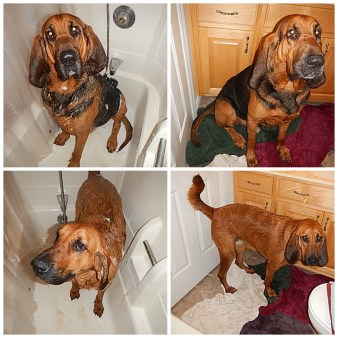
bloodhound bath

I did another Jillian 30 Day Shred workout in the afternoon and then hung out on the couch and watched the 2014 Kona Ironman. Pretty good end to the weekend, at least!

At this point, I’m still planning to run the Star City Half in Roanoke with Kim this Saturday. It’s the first time we’ve actually planned to run an entire race together, so I’m excited about that! Whatever is going on with my foot seems minor, so hopefully my Saturday plans will work out. We’ll see how things go this week.

How long do you typically take off after a big race? Is it based on how you feel physically or mentally?

Traditional Marathon Training vs. The Hanson Brothers

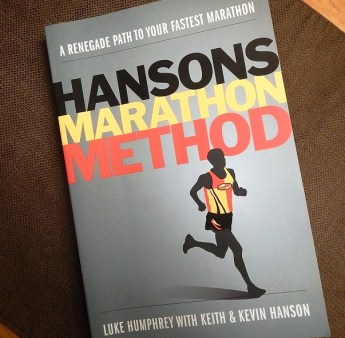
This past summer I began training for my second full marathon. I chose to follow the Hanson Marathon Method after reading the book and agreeing with their logic. For my first full marathon, I followed what I believe to be a ‘traditional’ marathon training program. I did three shorter/mid-length runs during the week and a long run on the weekends. My mileage slowly increased, with my long run maxing out at 20 miles. The Hanson program was a horse of a different color.

The Hansons version of training for a marathon was a lot different than a ‘traditional’ marathon training plan. The only similarities that I saw between the training plan I used last year and this year’s were that both involved running and were 18 weeks in length.

The Hanson plan involved a higher volume of running, but the bulk of it was at a much slower pace. Nearly 50% of the training plan was made up with easy runs. The other half of training involved tempo runs, speed workouts, interval workouts, and long runs.

Traditionally, tempo run means a shorter run done at a quicker pace. But for the Hansons it was a longer run done at marathon pace. It was a chance to internalize race day pace. The tempo run gradually increased in length over the weeks of training, requiring you to learn how to hit marathon pace as the circumstances changed and a variety of challenges were thrown your way.

Challenges like fitting in 10+ mile runs during the work week.

Training also included speed workouts early on which help you determine if you selected an appropriate finish time goal. They also helped build mental toughness. Then you step up to the third phase of training, where the marathon-specific interval workouts begin. Here, you learn to push through tough workouts on tired legs. One of the pillars of training is cumulative fatigue. The brothers don’t want you feeling fresh for any workout during training, because they want you to have your best day on race day. Cumulative fatigue brings me to another major difference between the Hansons and traditional training.

The long run is the anchor of marathon training. In traditional marathon training, the runner will typically peak with a long run between 20 – 22 miles. But the Hansons only have you peak at 16 miles. Granted, you do that long run three times, whereas most traditional plans only have you run your peak long run once or twice. The reason the 16 mile long run works is two fold. First, you’ve already run between 38 and 41 miles during the week leading up to that long run, which is on a Sunday. So the 16 miles really simulates the last 16 miles of the marathon instead of the first (because your legs are already fatigued). Second, exercise science has shown 2-3 hours is where you get the optimal gains in metabolic adaptations during long runs. Muscle breakdown begins beyond that 3 hour point. When I trained for my first full marathon, my 20 miler went really well. But a few days later I found myself sidelined with an injury. So in this case, the Hanson training plan was a better fit for me personally.

DSCN0731

The last discrepancy between the Hanson training plan and a traditional one was the taper. I won’t lie, it freaked me out a bit. The final workout was 10 days before race day, as the Hansons state it takes 10 days to realize the benefits from a hard workout. Then it was all easy running until race day. I’m accustomed to taking 1 to 2 days completely off before race day. But in keeping with the overall structure of the training plan, the Hansons actually had me running all 6 days (including the race) on race week. I ran the three days leading up to the race and my only day off was the Wednesday before my Sunday race. But, just as they promised, I arrived at the start line feeling fresh and ready to go. It makes no sense to me, but it worked.

I felt more prepared with the Hansons plan than I did with the traditional plan I used last year. It was also a better fit for me, personally. The run 3-4 days a week and long run on the weekend structure works really well for me for a half marathon, but I needed more for a full. The Hansons provided.

What type of training plan works best for you?
Do you like to try different training methods, or do you stick to the “tried and true”?

Training with the Hansons

This post is a review and recap of my experience with the Hansons Marathon Method training program. Later this week, I’ll have my comparison of a traditional training program and the Hansons program.

———————————————-

You always hear people say “never again” the moment they cross the finish line of their first marathon. But then in the hours and days to follow they often go back on that sentiment. For me, I knew I wanted to run another one as I was crossing the finish line of my first.

2013 Thunder Road Marathon

My first full marathon, the Thunder Road Marathon in Charlotte, was a small race. For marathon #2 I decided I wanted to experience the opposite – a big race. What better place to do that than at the Marine Corps Marathon, which was right in my Dad’s backyard? There were a few hoops to jump through, but once I was in it was time to decide how I was going to train.

For marathon #1 I followed a training plan similar to what I’ve done for all of the half marathons I have run: three shorter runs per week, one long run on the weekend, and one to two days of cross training. But for marathon #2 I wanted something different. Enter: Hansons Marathon Method.

Hansons Marathon Method

This training method is a self-described “renegade path to your fastest marathon.” It wasn’t a training plan meant for those who are training just to finish (although that is always one of my goals with a marathon). This training plan revolves around a time goal, and all of the paces are based on this.

After reading the book cover to cover, I was sold on the training program. I guess you could say I drank the Kool Aid, so to speak, and am a firm believer in their methods and the reasons behind them. The first part of the book spent a lot of time on the physiology behind training. It was more science than I needed, but definitely good supporting information for the skeptic. Then I got to part 2: The Training Plans. I chose to follow the Beginner Plan, as it was the best fit for me.

The plan involved six days of running per week, and little to no focus on cross training. The Hansons justify this by saying that if you want to run a race, you have to train by running a lot. Although they did provide types of strength exercises that would help supplement training, it wasn’t the focus of training. It was more running than I’ve ever done in my life, and at times I wasn’t sure I could complete what they were asking of me (hello very first track workout). But they seemed to know me better than I knew myself. What it really boils down to is that you should set a realistic goal for yourself, and therefore you should be able to handle the work to get there.

DSCN0341

Overall, I really liked the training program. It was tougher than anything I’ve ever done and it took a great time commitment. But I really thrived on the challenge. Unfortunately, the second half of training was riddled with injury and illness. This was not good, as this is when they introduce all of the marathon-specific training and your weekly mileage peaks. I wish I had gotten through training healthy so that I could have had a better feel for the results from training. All in all, I was able to complete 83% of the training plan as scheduled. But I missed some really key workouts, including one of the famed 16 mile long runs, during those 3 missed weeks.

The Hansons program basically included two types of runs: easy and something of substance (SOS). The SOS runs included track/speed workouts, tempo/marathon pace runs, strength/interval runs, and long runs. The easy runs were much slower than I was accustomed to, and they made up the bulk of training. This allowed me to safely add mileage to increase my overall weekly mileage, as well as actively recover from hard workouts, without risking injury. Actually, the only time I got injured during training was when I went and ran too fast at a relay. Hanson karma, right there.

DSCN2535

I’ve often heard people refer to easy running as ‘junk mileage’ but I don’t agree with that. I think easy days are as important to a training plan as the tough workouts. I also think if you make every run a ‘something of substance’ run you will end up injured or burned out.

In addition to the types of runs incorporated during training, the 18 weeks of training also had three main phases. The first phase (weeks 1 – 5) were a base building phase, made up solely of easy running and gradually increasing mileage. Phase two (weeks 6 – 10) incorporated track workouts, tempo runs, and long runs. The mileage and length of those SOS workouts continued to steadily increase during this time. The final phase (weeks 11 – 17) is where the marathon-specific training kicked in. Interval workouts, which were longer repeats done on a flat stretch of road or bike path, replaced shorter track workouts. The tempo runs increased in length, maxing out at 12 miles. Finally, the long run peaked at 16 miles.

DSCN2309

My favorite workouts during training were the longer track workouts (5 x 1K and 4 x 1200m) and the interval workouts (even though I called the Hanson brothers crazy when they told me to do 6 x 1 mile). I seem to thrive on repeat-type workouts and for some reason I always felt my strongest during these. Which is kind of strange, since they fell on a Tuesday, which was my sixth day in a row of running. Throughout training one thing held true: the longer the interval, the more I enjoyed the workout.

Myrtle Beach High School Track

My least favorite workout during training was the tempo runs. For the Hansons, a tempo run is synonymous with a marathon pace run. These workouts involved a 1 mile warm up, 1 mile cool down, and some middle miles at marathon pace. They started out at 5 miles and increased to 10 miles over the course of training. These runs were the perfect time to practice marathon pace and teach your brain what pace to run on race day. I just never could nail these runs. Maybe it was an indication that I had chosen the wrong goal, but I don’t really believe that. I just found these long, midweek runs daunting. They were always on Thursdays, which was the day after my one treasured rest day. But I usually felt creaky and stiff instead of fresh during these runs.

All in all, I am definitely a believer in the Hanson Method. When I do train for another marathon, I will use this plan again. One major change I’ll probably make: no racing during training. This will help me stick to the prescribed schedule and specific training paces. It’s not the kind of running schedule I would keep outside of training for a marathon. But it was a great fit for me for marathon-specific training.

What type of structure do you follow for training?
What type of workout is your favorite?

The calf who thought she was a dog

I have a dog named Hank who thinks he is a cow. This is probably due in part to his spending a lot of time around cows when he was a puppy.

IMG_20140226_182217_538
Scratching his chin like a cow.
DSCN3734a
Communing with his fellow comrades.

I have another dog named Scout who thinks she is a human. I don’t really know why she thinks this, but it’s clear in almost everything she does. Especially in the way she sleeps- preferably with a pillow and blanket.

IMG_20141013_125120

IMG_20141030_212531_150

IMG_20140119_154358_006

And now I have a heifer calf named Annabelle (also now known as ‘Peanut’ to Barry – I’m not the only one who got attached) who thinks she is a dog.

DSCN2677

Her story is kind of the opposite of Hank’s. She is spending her young, impressionable first weeks of life with Hank and Scout. Naturally, she thinks she’s one of the gang.

You and me, we're buddies.
You and me, we’re buddies.
Annabelle likes to follow Scout.
Let's run together!
Let’s run together!
Helping Hank check on the chickens.
More running together. Such fun!

In addition to tagging along with the dogs in the backyard, Annabelle has now also started drinking her milk from a bucket, in an effort to be more like Hank and Scout. Just kidding! She’s drinking milk out of a bucket now because it’s easier on us than bottle feeding her. Not to mention she decided she didn’t want to drink out of a bottle anymore about a week and a half ago.

Calf Collage

Scout is especially happy that Annabelle now drinks her milk from a bucket. That’s because Scout likes to lick the milk off of Annabelle’s chin afterwards, which Annabelle seems to enjoy too. At five weeks old, Annabelle has also started to eat some grass, grain, and drink water!

So Hank thinks he’s a cow, Scout thinks she’s human, and Annabelle thinks she’s a dog. However, we do have one group who is sure of themselves.

DSCN0795a

The chickens are pretty sure they’re birds. At least, that’s the consensus for now.

Do you have any animals that are confused about what they are?

Untold Stories from the Marine Corps Marathon – Part 2

This is part two of a bunch of “fluff” stories from the Marine Corps Marathon. If you missed it, you can find part 1 HERE!

Semper Fi, Big Guy!

Part way through the race I figured something out. Typically, if you tell a Marine “Semper Fi!” they will say it back to you. And if you tell them “Oorah!” they will also say it back to you. Now this only works with a male Marine (at least, I never tried it with a female), but if instead you yell “Semper Fi, big guy!” you will get a very enthusiastic “Oorah!” yelled back at you in return. I had a lot of fun with that along the race course once I made that discovery 🙂

[source]
Woman on a stick

This story is an odd one. At mile 20, just as we were beginning our trek across the 14th Street Bridge, there was a guy standing on the side of the road with this:

2014 Marine Corps Marathon

He was yelling “Woman on a stick! I’ve got a woman on a stick! Woman on a stick for you!.” I have no idea if it was some kind of inside joke or if he just wanted to make something really bizarre to entertain the runners.

During the race I also saw a lady holding a giant poster of a hot dog, and several people dressed up as Santa Clause, Ninja Turtles, and condiments (ketchup, mustard, and relish). I guess the latter can be justified by Halloween being right around the corner from the race. But that woman on a stick… it certainly was the most bizarre thing I saw along the course!

What happened at mile 20?

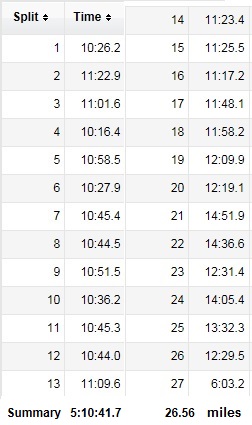
So things were going well up until mile 20. I wasn’t running the pace I had hoped to run, but things were still going. I had been fighting for nearly 6 miles at that point to keep running and I kept waiting for a third wind (or was I needing my fourth at that point? I’m not sure). As soon as I crossed the mile 20 mark, I suddenly slowed to a walk. I just couldn’t fight anymore. And once you start taking walk breaks in a race, it’s awfully hard to stop.

splits
Splits from the race. You can see exactly where I started struggling a bit (miles 14-19) and where I fell apart (mile 21).

But here’s the thing. Making it to mile 20 and battling to that point was a really big accomplishment for me. I’ve never actually run 20 miles without stopping before. I had to dig really, really deep and push past barriers I’ve never pushed through to get to that point.

In the days following the race, a small voice in my head kept wondering if I had pushed harder at mile 20, could I have kept running? Could I have finished the race in under 5 hours? I had A, B, and C goals for the race and I missed them all. My A goal was 4:30, B goal was sub-5, and C goal was 5:04 (which would have been a 30 minute PR).

But then another voice says that deep down, I truly feel like I did my best on that day. I had already been fighting for so long, and I’m very proud of that. But now that I’ve had that achievement, I wonder if there’s another wall I can push through and if I can actually run an entire marathon from start to finish…. so is there another full marathon in my future? Absolutely. When will it be? No idea!

Will I run MCM again?

Heck yes, without a doubt! I don’t know if it will be next year or 10 years from now, but I’ll be back.

2014 Marine Corps Marathon

What’s the most bizarre thing you’ve seen during a race?
Do you like to run races multiple times, or are you more one and done?

"I've opted for fun in this lifetime." -Jerry Garcia