There was an article about spectators in the July 2013 Boston Special Issue of Runner’s World, written by Mark Remy. Many of the articles in the 48 page special are heart wrenching, but this particular article about spectators, called Standing Ovation, was uplifting. In case you didn’t get to read this article, I am going to share a passage with you that I particularly enjoyed. It’s a bit long but it’s worth it. I added in some pictures to go along with the passage.
“This is what many folks outside the world of running may not fully appreciate: The attack at Boston wasn’t just an assault on innocent bystanders. It was an assault on innocent bystanders who had come together to cheer for marathon finishers. In this sense, the Boston bombings were — for me, anyway — an attack on this relationship itself, on the bond between the people who run and the people who root for them. And not just those who happen to be family or loved ones, either. I mean friends, co-workers, neighbors, college students, total strangers. At any marathon, but especially at a race like Boston, they turn out in droves to stand there and cheer. They are absolutely crucial.
 |
|
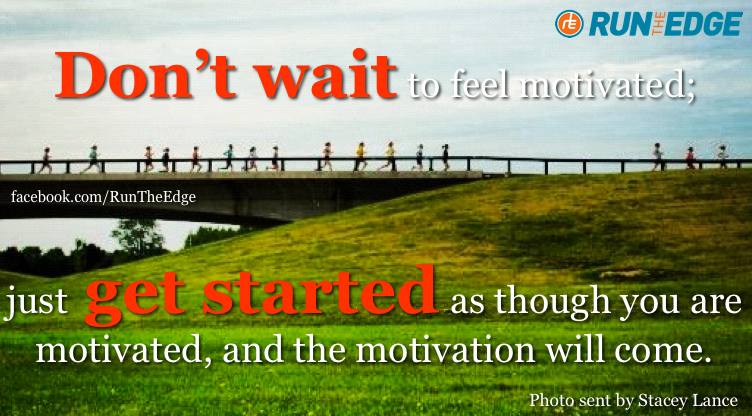
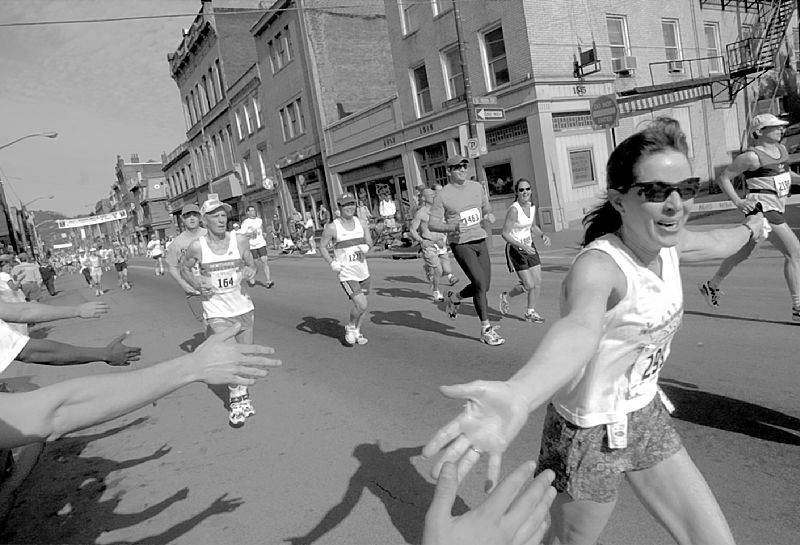
In fact, the word spectator — from the Latin spectare, “to observe” — seems inadequate. It suggests passivity, and crowds who turn out for marathons are anything but passive. Marathon spectators shout. They clap. They play bagpipes and kettle drums. They rattle cowbells and scream you name, if they know it. If they don’t, they latch onto any identifier — “Go, Team in Training!” “Go, Sparkly Skirt!” “Go, Runner’s World!”
They hold handmade signs that make you laugh. (“You Should Have Taken a Dump When You Had The Chance.”)
It’s funny — a crowd supporting another crowd. You would think that having so many people cheering for so many other people would dilute the impact for any given runner. You would think that a single, random runner passing hundreds or thousands of roaring strangers couldn’t possibly feel special. You’d think that. But you’d be wrong.
I’ve been buoyed by people cheering by name for the guy next to me, and by “Go Mommy” and “Go Daddy” signs held up by someone else’s kids. I call this “secondhand inspiration.”
It’s a cultural universal: Every year, untold millions of spectators materialize to urge runners on at marathons around the world. Boston alone attracts an estimated 500,000. I don’t know when or where, exactly, turning out to watch other people run became a “thing.” (It’s odd, isn’t it, when you stop to think about it?) But I’m glad it is I can’t imagine ever running 26.2 miles without the crowds. And yet it’s easy to take them a little bit for granted.
Maybe this is because marathon spectators are kept, literally, on the margins — they line the roads and streets and jam themselves onto sidewalks, pouring their energy and attention outward, at the multitude of runners streaming past. At large marathons, there’s no mistaking who’s performing and who’s in the audience.
Or maybe it’s because our own private “support crews” are so good at what they do. During months of training, they put up with our aches and pains; they watch us vanish for hours at a time to do our workouts and long runs; they listen to us blather on about mileage and nutrition and ice baths. They indulge us.
On race weekend, of course, they’re the ones who kick into high gear just as we’re downshifting to prepare for race day. They travel along with us, carrying our stuff and eating when, and where, we want. They soothe our nerves. They study course maps to plot out where they’ll have the best chances of seeing us. They wonder whether, logistically, they can catch us at mile three and again at mile 11, and still make it to the finish on time, if they hustle They stand, often in poor weather and often for an hour or more, staring at a sea of grimacing runners as they wait for their grimacing runner to appear. And when we do, they go nuts.
They do all of this for us.
Not only that, but they do it with humility. How many times have you heard a runner’s spouse or partner at a race say that he or she is “just here to watch”? Just!
The tragedy in Boston spawned several social media memes. One was the notion that, in the face of this horror, “We are all runners.” It’s a fine sentiment, but I’d tweak it just slightly. On April 15, in the space of 13 awful seconds, we all became spectators. (Even those of us who are, in fact, runners.) As events unfolded, we sat and watched. But we rallied, quickly and loudly. We came together to voice support, to assure the victims — and each other — that we’re strong and we’ll get through this.
If that doesn’t say “spectator,” I don’t know what does.”
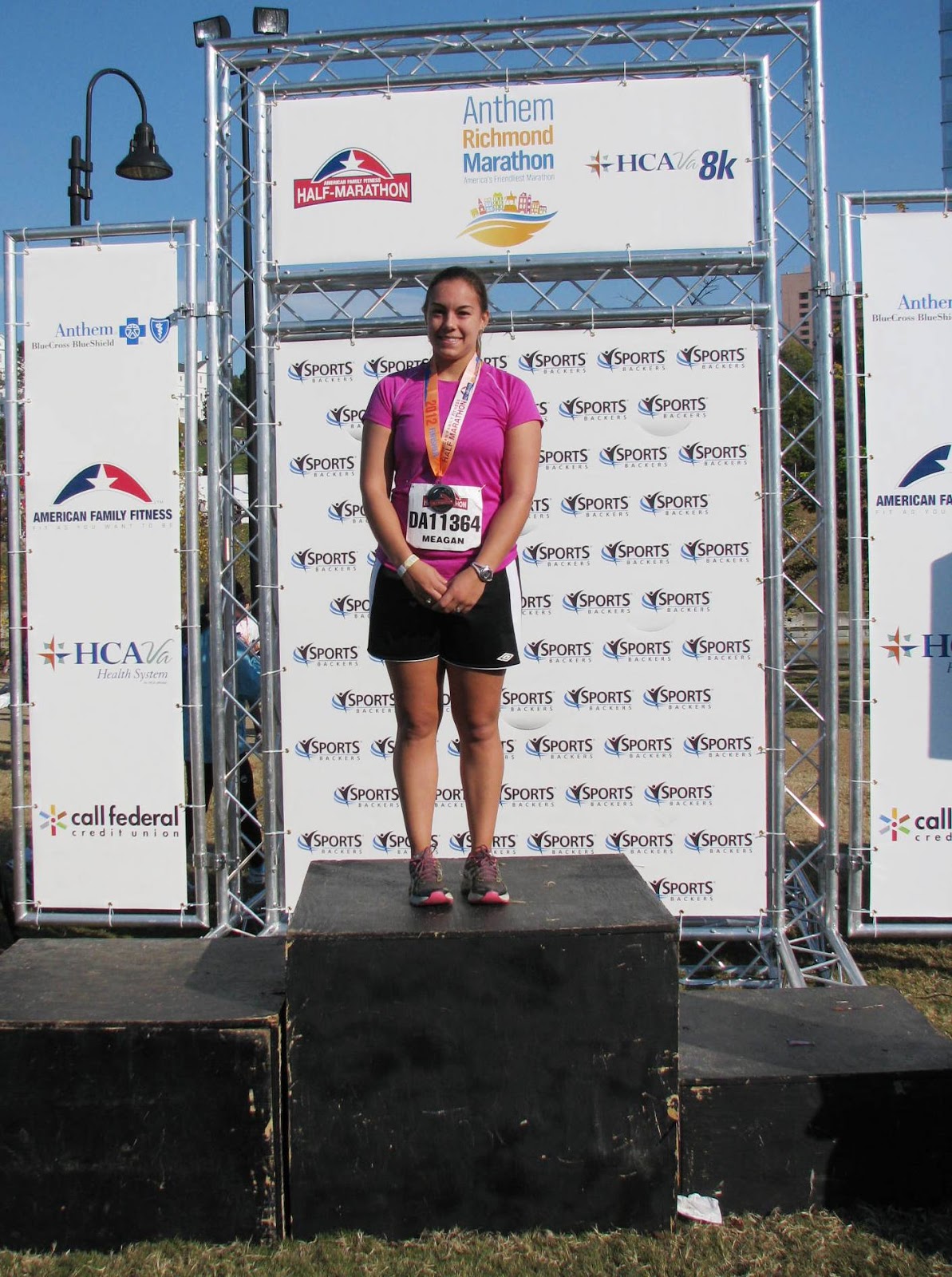
I hope you stuck through to the end of that excerpt, because it speaks volumes to how special spectators are. In the past my parents and sister, as well as Barry’s parents and his sister have traveled to our races just to cheer Barry and me on. When I ran the American Family Fitness Half Marathon last fall in Richmond, my Dad biked over 20 miles around the city to see me 4-5 times during the race. I ran my PR at that race, 2:01:00. There’s no way I would have been able to hang on without having him to look forward to every few miles (my dad is probably rolling his eyes reading this, because I’m being sincere).
Our families coming out to support Barry and me at our races means more to me than they know. I don’t want to speak for Barry, but I’m pretty sure he’d say the same. Knowing you have a familiar face waiting for you at “X” mile marker keeps you going when the going gets tough. Make sure you let those who support you know how much you appreciate them.
Did you read the full article in Runner’s World?
Who supports you in your sport?